CRU Area Certificates: BOMA GLA for Retail Leases in Alberta
A CRU area certificate is a dated, dimensioned plan that records the measured Gross Leasable Area (GLA) of one commercial retail unit under ANSI/BOMA Z65.5, so the area in the lease matches the space on the floor.
If you lease or manage retail space, the area of each Commercial Retail Unit (CRU) is the number behind base rent, percentage rent, CAM charges, tax allocations, and the centre’s reported GLA.
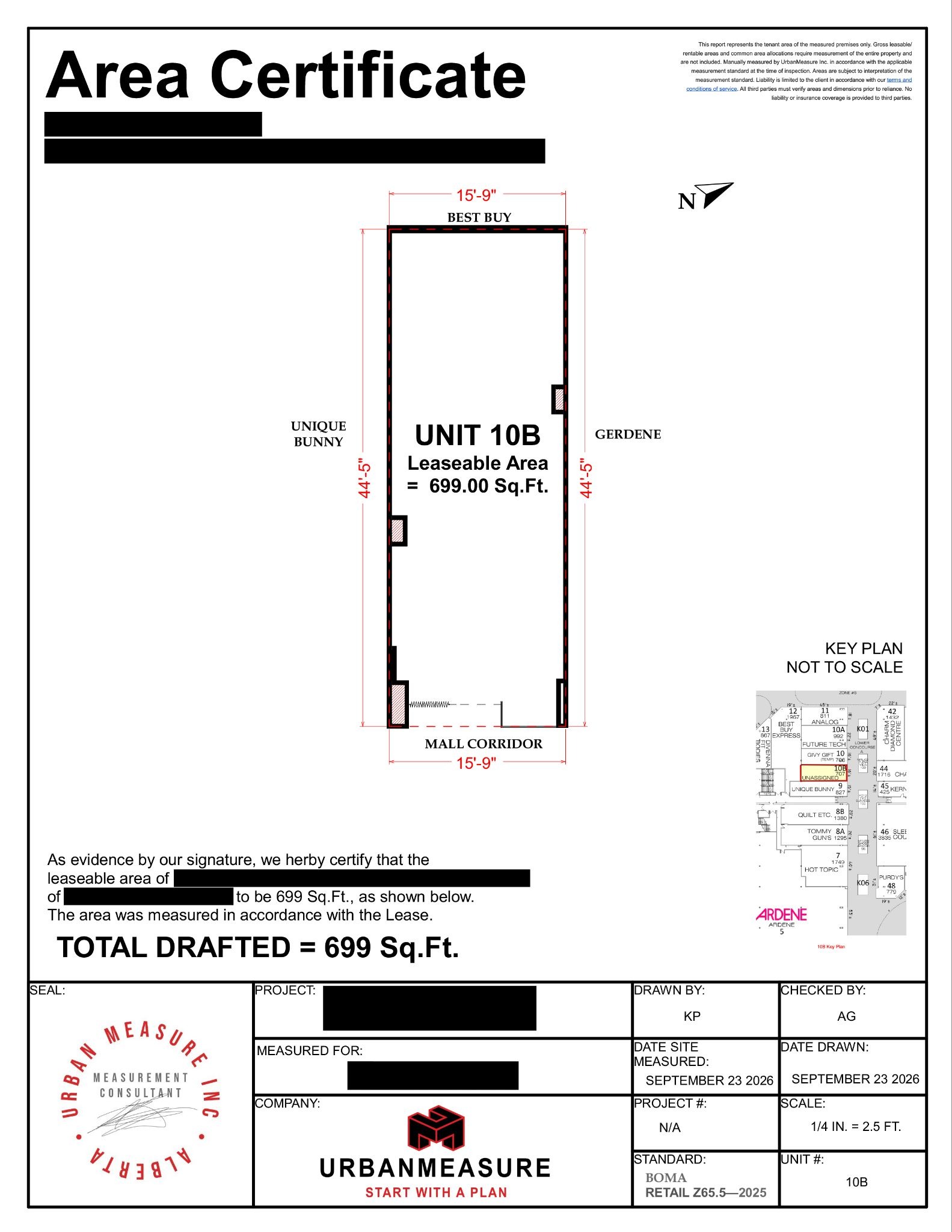
An area certificate is the as-built record of that number. It shows the measured area and lease-line dimensions of a single CRU so the figure in the lease matches the space on the floor.
UrbanMeasure prepares these certificates for retail landlords and REIT portfolios from offices in Calgary and Edmonton, with work across Alberta, British Columbia, and Saskatchewan.
What is a CRU area certificate?
A CRU is the individual store, restaurant, clinic, bank, salon, or service bay in a shopping centre, power centre, lifestyle centre, or strip plaza. Anchors and common mall area are tracked separately. The CRU is the unit most retail leases are written against.
- CRU: commercial retail unit, one leasable store or bay.
- GLA: Gross Leasable Area, the area a retail tenant pays rent on.
- Demising wall: the wall between two units, measured to its centreline.
- Lease line: the boundary of the leased premises, often the storefront closure.
An area certificate is not a marketing plan, and it is not the original architect’s drawing. It is a dated, dimensioned record of one unit after the space has been measured on site. A usable certificate usually includes:
- CRU number and property address
- Certified Gross Leasable Area
- Lease-line and storefront dimensions
- The measurement standard and edition used, most often ANSI/BOMA Z65.5
- A dimensioned plan of the unit
- The measurement date and the conditions observed on site
Some enclosed centres also keep a storefront or tile drawing that shows where mall tile ends and tenant tile begins. That line is worth updating after a new storefront is built, because fixturing often moves the closure past the original offer drawing.
Why does a measured certificate matter for rent and CAM?
A lot of CRU areas in older lease files still come from construction drawings, a merchandising plan, or a tenant fit-out set. Those drawings show what was designed. They do not always show what was built, and they rarely show the unit after years of demising-wall moves and storefront rebuilds.
That difference shows up in:
- Base rent and percentage rent over the term
- CAM and tax recovery, which are allocated against GLA
- Renewals, assignments, and estoppels
- Portfolio GLA, occupancy, and sales per square foot
The certificate does not invent area. It records the area the named standard allows, measured to the walls that are actually there.
Who asks for CRU area certificates?
- REITs and private-owner property managers updating rent rolls and lease exhibits
- Leasing teams attaching an area schedule to an offer
- Tenants and tenant reps checking the area they will pay rent on
- Counsel closing leases, assignments, and financings
- Appraisers and lenders tying value and debt to reported GLA
- Tenant coordination teams confirming a finished storefront stayed on the lease line
For a centre with dozens or hundreds of CRUs, the certificate file is how unit areas remain consistent from one deal to the next.
Which BOMA standard applies to a CRU?
Retail unit area in North America is measured under ANSI/BOMA Z65.5, the Retail Properties standard. Many existing leases still name the 2020 edition. A 2025 edition is now published (see BOMA International’s standards page). Put the edition from the lease, or from the owner’s measurement protocol, on the certificate. Older methods can still be used where the lease requires them, but the edition has to be stated.
The rules that most often change a CRU figure:
Retail walls take priority. Measure to the exterior face of exterior walls, including wall and cladding thickness. On a demising wall shared with another retail unit, measure to the centreline. Retail area generally takes the wall thickness over common or service space.
Included in GLA
- The occupant area the tenant uses for the business
- Leased kiosks
- Occupant voids inside the unit, including double-height sales floors
- Shafts that serve only that unit
- Qualifying covered exterior areas, including some restaurant patios
Excluded from GLA
- Parking
- Major vertical penetrations that serve more than one unit
- Mall walkways, public washrooms, management offices, and shared loading
The certificate should also say whether the work is a partial measurement of one or more CRUs or part of an overall measurement of the property. Partial measurement is the usual request for a new deal, a renewal, or a post-fixturing check. Overall measurement is the better basis when the owner also needs to allocate parking, major verticals, and service areas for CAM and tax.
For the retail standard in more detail, see Retail Properties: ANSI/BOMA Z65.5-2020 Measurement Standards.
What should a CRU area certificate include?
A certificate that will sit in a lease binder needs more than a highlighted shape and a total.
- CRU ID and address, so the exhibit matches the lease
- Certified GLA
- Standard and edition
- Lease-line dimensions
- Storefront width
- Notes on voids, exclusive shafts, and any qualifying covered area
- Notes on shared mall, shared verticals, and parking left out of the unit
- Measurement date
- Partial vs overall method
- A dimensioned plan
If the unit was measured after fixturing, the plan should show the finished storefront, not the line from the offer package.
When should a CRU be remeasured?
- Before the offer goes out, if the demise may have changed
- At lease execution, as the area exhibit
- After tenant fixturing or a storefront rebuild
- On renewal, assignment, or expansion
- When two CRUs are combined, or one is split
- On acquisition, refinancing, or a full GLA restack
- When a renewal names a different BOMA edition than the last certificate
A practical portfolio approach is to issue unit certificates as deals happen, then remeasure the centre on a cycle so the unit file and the property GLA roll still agree.
What changes a CRU’s area?
Public-facing clinics in a retail bay. If the space is open to the public in a retail property, Z65.5 is usually the right standard, not the office standard.
Restaurants with covered patios. Qualifying covered occupant area can add a large block of GLA. Show the patio on the plan.
Kiosks and RMUs. Leased kiosks count as GLA and are easy to miss if the drawing set only covers inline bays.
Double-height sales floors. Occupant voids inside the unit are included. Older plans often omitted them.
Exclusive shafts. HVAC, grease exhaust, medical gas, or plumbing shafts that serve only that CRU stay in that CRU’s area.
Mezzanines and stock basements. Include them when they form part of the tenant’s occupant area under the standard.
Storefronts that moved. In enclosed malls, the finished closure line is the most common correction after occupancy.
If the unit is being renovated, start with retail as-built drawings.
Examples from typical retail files
Inline CRU quoted from an old merchandising plan. A fashion bay was offered at 1,240 sf from a 12-year-old centre plan. Field measurement to Z65.5, using retail wall priority and the actual demising construction, came in at 1,315 sf. The difference was wall thickness and a small exclusive shaft the old plan had treated as common.
Restaurant patio left off the lease exhibit. A 3,800 sf restaurant had been using a covered patio that never appeared on the area schedule. Under Z65.5, the qualifying covered area added 620 sf, which became the number used at renewal.
Two CRUs combined for a national tenant. The property file still held two certificates after the wall came down. One post-construction certificate captured the new demise, the removed wall, and the new storefront width, so the rent roll had a single GLA line.
Acquisition restack. An incoming owner inherited a mix of enclosed and strip units with areas from three generations of drawings. Measuring every occupied bay to the same standard rebuilt the GLA roll. Some units increased once voids and exterior-face rules were applied the same way; a few decreased where older plans had counted shared service space.
CRU area certificates in Calgary and Edmonton
UrbanMeasure is a preferred measurement provider for several major REIT companies. That work is a repeatable certificate program: the same field method, the same drawing standard, and the BOMA edition named in the lease.
We have recently completed several projects for malls in Calgary and Edmonton. Those assignments included CRU area certificates, as-built plans, and BOMA area analysis for leasing and asset management. We also work throughout Alberta, British Columbia, and Saskatchewan. UrbanMeasure has over 20 years of experience measuring in operating malls and stores. We get in and out with as little disturbance as possible and know the right questions to ask, i.e., where the lease lines are. Our Calgary measurement technicians hold Architectural Technologist diplomas from SAIT.
Area certificates are typically delivered within three business days of the site visit, which matters when leasing is waiting on the exhibit. Every unit is hand-measured to 1/10 inch and checked against the conditions on the day of the visit. Out-of-area travel fees apply. Certificates can follow the owner’s CRU numbering and CAD standards so they drop into the existing lease file.
Related services include as-built drafting and CAD, marketing floor plans, photography, drone and aerial photography, and 3D tours.
How do I get a CRU area certificate?
If you need a certificate for a new deal, a storefront verification, or a full-centre GLA update, UrbanMeasure will measure the unit, apply the retail standard named in the file, and deliver a dimensioned plan that can go into the lease.
For mall and portfolio work in Calgary, Edmonton, and across Western Canada, send the CRU list and the standard edition required. We will match the naming and format already in use on the asset.
Get a quote for CRU area certificates · Calgary 403-827-4420 · Edmonton 587-598-4420 · Toll-free 1-844-504-4420 · info@urbanmeasure.com · Head office: 4034 16th Street SW, Calgary, AB T2T 4H4
CRU area certificate FAQ
How long does a CRU area certificate take?
Area certificates are typically delivered within three business days of the site visit.
How accurate is the measurement?
Each unit is hand-measured on site to 1/10 inch and drawn to the BOMA edition named in the lease.
Is GLA the same as rentable area?
No. Retail units are measured as Gross Leasable Area under ANSI/BOMA Z65.5. Rentable area is the office measure under ANSI/BOMA Z65.1.
Which BOMA edition should the certificate use?
The edition named in the lease or the owner’s measurement protocol. Many leases cite Z65.5-2020; the 2025 edition is now published.
Do you measure outside Calgary and Edmonton?
Yes, across Alberta, British Columbia, and Saskatchewan. Out-of-area travel fees apply.
Related UrbanMeasure services
- As-built drafting, elevations, and LiDAR scanning
- ANSI/BOMA measurements and CRU area certificates (Z65.5 retail)
- Marketing floor plans, photography, drone, and 3D tours
Written by Ken, BOMA Specialist / Architectural Technologist at UrbanMeasure.