
Mixed-Use Properties: ANSI/BOMA Z65.6-2021 Measurement Standards
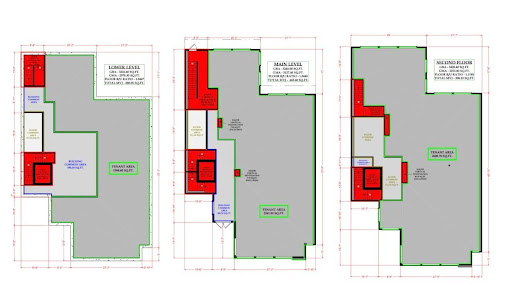
Mixed-Use Properties: Standard Methods of Measurement ANSI/BOMA Z65.6-2021
Your Complete Guide to Full-Building Measurement & Fair Common-Area Allocation
Today’s real estate market is full of mixed-use developments - buildings that combine retail [note to self: add link to new retail post], office[note to self: add link to new office building post], residential, hospitality, industrial[note to self: add link to new industrial post], or other uses under one roof. When a property doesn’t have one clear “primary use,” or when governing documents (Covenants, Conditions, and Restrictions (CC&Rs), ground leases, or condo declarations) require it, you must use the ANSI/BOMA Z65.6-2021 standard.
This measurement standard is not for measuring individual tenant suites.
Rule #1: For any single unit (apartment, retail shop, office suite), always use the specific single-use BOMA standard that best fits that unit’s primary purpose (Z65.1 Office, Z65.5 Retail, Z65.4 Multi-Family, etc.).
Z65.6-2021 is used exclusively for full-building measurements to create fair, proportionate allocations of shared Mixed-Use Common Areas across the different use components throughout the entire building.
Here’s the clear, step-by-step breakdown every owner, developer, property manager, appraiser, and lender needs to know.
When to Use the Mixed-Use Standard (Z65.6-2021)
Apply this standard when:
- The building has no easily identifiable primary use (e.g., 40% retail + 35% residential + 25% office). [is there a % where a primary use becomes non-debatable ie 70% 80%. Is this % specified in the standard, or is a building’s primary use open to interpretation? At what point does a building become clearly office or commercial? Please specifiy]
- The property’s governing documents classify it as mixed-use.
- You need to allocate shared lobbies, elevators, mechanical rooms, loading docks, amenity decks, or parking fairly among different use types.
The Three-Step Process (Simplified in the BOMA 2021 Update)
Step 1: Establish the Mixed-Use Boundary Area
Measure the entire building (or defined mixed-use portion) using consistent exterior or centerline methods. This creates the overall “Mixed-Use Boundary Area” — the total gross area from which everything else flows.
Step 2: Subdivide the Mixed-Use Boundary Area
Break the total area into two main categories:
- Mixed-Use Components - the actual usable areas for each distinct use (Retail Component, Office Component, Residential Component, etc.). Each component is measured using its own single-use BOMA standard.
- Mixed-Use Common Areas - shared spaces that serve more than one use component (central lobbies, shared mechanical rooms, common corridors, amenity spaces, structured parking that serves multiple uses, etc.).
Step 3: Handle Special Conditions
Address these key items that often cause disputes:
- Interior Door Setbacks should be treated consistently across mixed-use components. Interior door setbacks are a common building safety practice that moves swing doors out of the way of exit corridors so that they do not interfere with people’s movement in case of an emergency.
- Non-compatible Single-use BOMA Standards - when one component’s rules don’t perfectly align with another, the Mixed-Use Standard provides reconciliation methods. [Please provide 1-2 sentences on the reconciliation methods]
- Parking Areas are to be allocated proportionately based on each component’s relative size (or per governing documents).
- Vertical Service and Circulation Areas (elevators, stairs, shafts) should be classified and allocated as Mixed-Use Common Areas unless they serve only one component.
The result? Every Mixed-Use Common Area is allocated proportionately to each component based on its relative size within the total Mixed-Use Boundary Area. This creates fair load factors and expense allocations for every use type. Load factor is the ratio between Usable Square Footage (USF) and Rentable Square Footage (RSF), where RSF includes the tenant's USF plus a proportionate allocation of common areas.
Practical Case Studies: Real-World Application of Z65.6-2021
Case Study 1: Downtown Mixed-Use Tower (Retail + Office + Residential)
A 180,000 sf building has 45% ground-floor retail, 30% upper-floor offices, and 25% luxury apartments sharing the same lobby, elevators, mechanical penthouse, and rooftop amenity deck.
Under Z65.6-2021:
- Step 1 establishes the full Mixed-Use Boundary Area.
- Step 2 measures Retail using Z65.5, Office using Z65.1, and Residential using Z65.4.
- Shared lobby, elevators, and amenity deck become Mixed-Use Common Areas.
- Allocation is strictly proportionate to each component’s size.
Result: The residential owner pays only 25% of the elevator and amenity costs instead of 50%, eliminating years of arguments and enabling accurate Common Area Maintenance (CAM) billing and condo association charges.
Case Study 2: Suburban Lifestyle Center with Parking Garage
A 320,000 sf property combines anchor retail, inline shops, and a small office component with a 600-space structured parking garage that serves all uses.
Under the 2021 standard:
- Parking is treated as a Mixed-Use Common Area.
- Allocation is based on each component’s relative square footage (or per lease terms).
- No single use “owns” the garage.
Result: Fair expense recovery for the developer; retail tenants no longer subsidize office parking, and financing was easier because lenders could clearly see proportionate load factors.
Case Study 3: Adaptive Reuse Warehouse into Live-Work-Create Space
An old industrial building is converted to 60% creative office/loft residential and 40% ground-floor retail/art galleries. The loading docks and vertical shafts are shared between all the use components.
Under Z65.6-2021:
- Non-compatible standards (Industrial vs. Retail vs. Multi-Family) are reconciled in Step 3 (Handle Special Conditions).
- Shared loading docks and vertical circulation are allocated proportionately.
Result: The project achieved clean, defensible measurements that satisfied lenders, tenants, and the city - increasing the property’s appraised value by clearly documenting how common costs are shared.
Why BOMA Z65.6-2021 Matters in 2026
The 2021 update dramatically simplified the process relative to the 2012 version while maintaining full compatibility with all other BOMA single-use standards. It delivers:
- Proportionate, transparent allocation of every shared dollar
- Fewer lease and condo disputes
- Stronger appraisals and financing packages
- Accurate benchmarking across truly mixed-use assets
Whether you’re developing a new vertical mixed-use tower, converting an old factory, or remeasuring an existing lifestyle center, ANSI/BOMA Z65.6-2021 is the mandatory framework for full-building measurement.
See our companion pieces on measurement methods for retail spaces [note self: add link], commercial spaces [note self: add link] and office buildings [note self: add link] if you found this guide helpful!
Why Lessors and Commercial Tenants Trust UrbanMeasure
Need help applying BOMA Z65.6-2021 rules to your project? At UrbanMeasure, accurate property measurement has been a core part of our work for over two decades. We are happy to review your floor plans, walk through the three-step process on a real mixed-use building, or explain how to allocate parking and vertical circulation fairly.
Our team specializes in hand-measured, professionally verified property measurements that comply with applicable measurement standards and reflect the conditions observed at the time of measurement.
In addition to measurement services, UrbanMeasure also provides:
- Professional real estate photography
- Drone and aerial photography
- Marketing floor plans
- 3D tours and video marketing
By combining accurate measurement with high-quality visual marketing, we help real estate professionals present properties with clarity, confidence, and professionalism.
Measure once. Allocate fairly. Maximize value and minimize disputes.


